
🚀 The Last Weekend Before School Starts | Life Notes
Before the school starts, I did several things to prepare, including RCL application, English placement test, moving into the dorm, and participating in activities arranged by the school for exchange students.
Before the official start of the semester, this weekend turned out to be a bit more than I had originally anticipated.
Looking back, this time didn’t feel so much like “preparing for classes,” but rather like slowly placing the last few pieces of the puzzle of my exchange life into the right positions. This article serves as a journal entry, documenting a few important things I accomplished before the semester began.
RCL Application: A Familiar Yet Challenging Process
The application process for RCL (Reduced Course Load) itself is not complicated, but it requires some documentation and a meeting with a school counselor.
As someone who has long coexisted with depression, this process is not unfamiliar, but each time I go through it again, it still consumes some mental energy.
The entire process is roughly as follows:
- Fill out the KOKUA form, describing my current physical and mental condition
- Schedule and complete a meeting with the counselor
- Fill out the needs form (I applied for a reduced credit load, cutting it directly in half)
At this point, the RCL application is basically complete. Subsequent updates related to my visa seem to be handled by ISS (International Student Services). I didn’t personally go through this part of the process, so I can’t say for sure.
Fun Fact 💡 KOKUA means “help” in Hawaiian, not just in a formal sense, but as a support that allows people to continue moving forward.
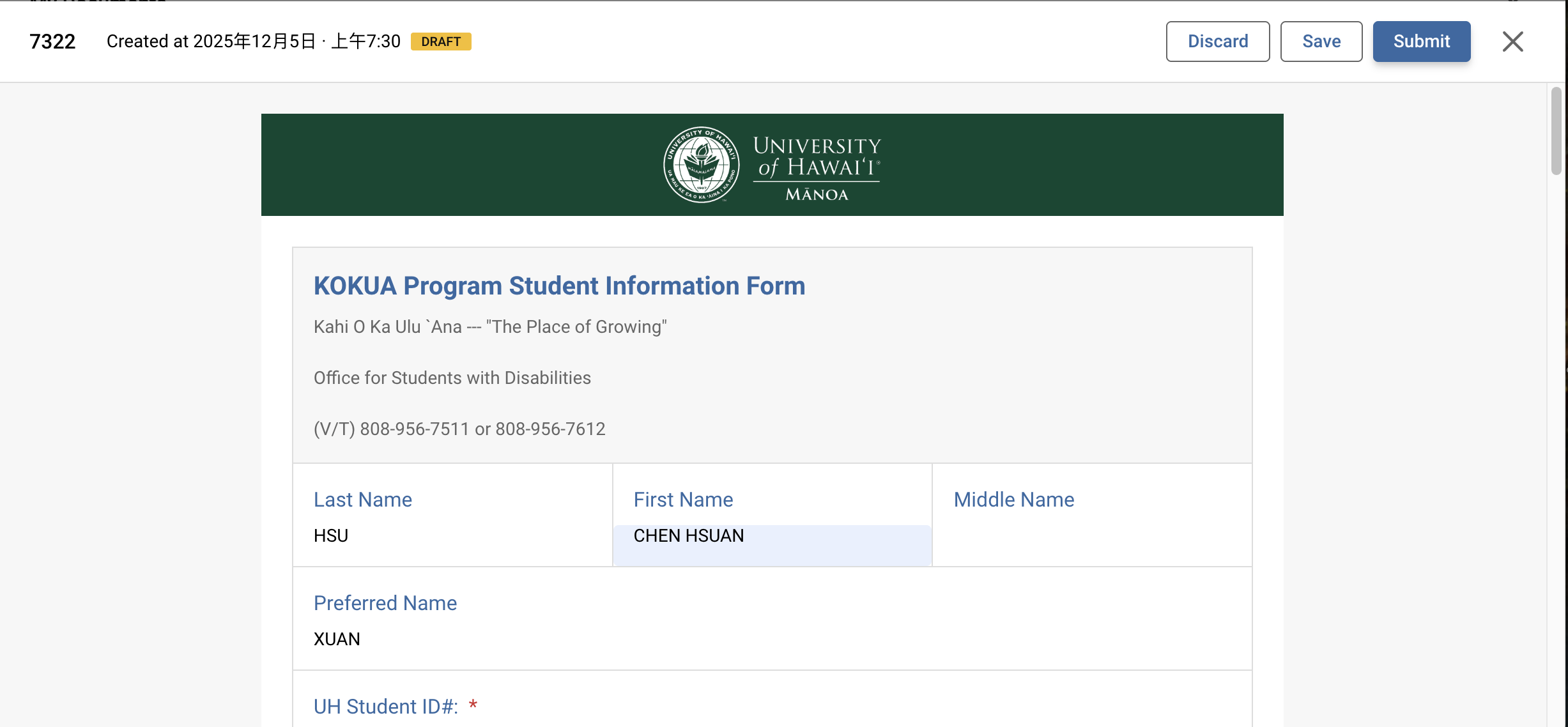 Form style
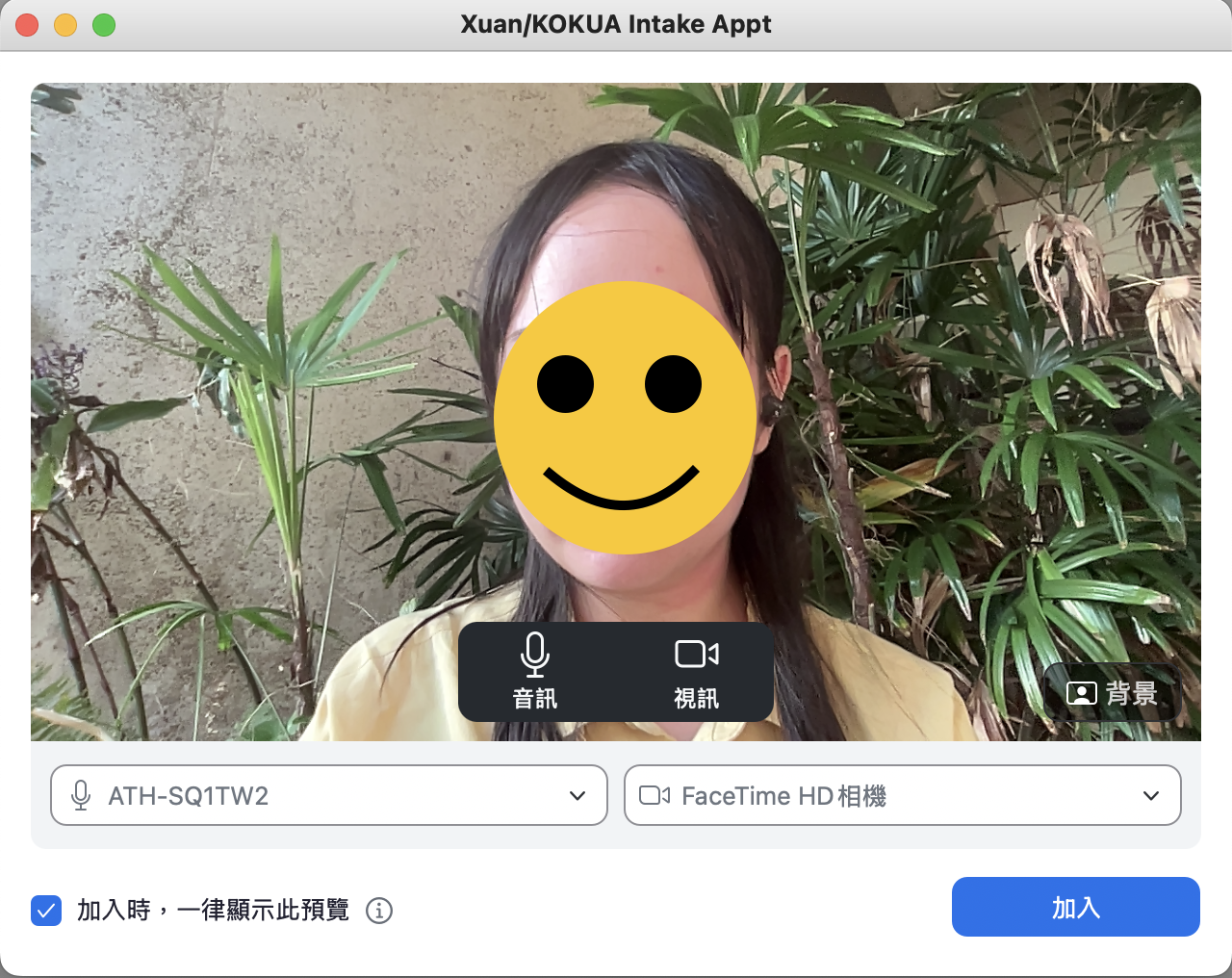 The counselor meeting was super early (8:30 AM), and I spoke with her via Zoom while sitting on a bench in front of a school building
About Seeking Help: A Huge Cultural Difference
During the process of handling the RCL application, I experienced something that surprised me —
Here, for “students in need,” help is not something that requires repeatedly proving how “serious” your situation is to receive.
Whether it’s administrative staff, counselors, or relevant school units, as long as they know your situation, they often take the initiative to ask:
Is there anything else you need?
Would you like more support?
This attitude is quite unfamiliar to me.
In my educational experiences in Asia, I had long been accustomed to digesting problems on my own, to holding on and enduring first, and even doubting “am I too weak?” Many times, seeking help means bothering others and also means carrying a certain psychological burden.
In contrast, the campus culture in the United States seems more inclined to view “expressing needs” as a reasonable and respected behavior. You don’t need to explain too much, nor do you have to apologize for your condition.
However, for someone who is already used to facing things alone, the real difficulty is not the system, but —
I almost forgot how to ask for help.
This RCL application also serves as a reminder:
Being supported doesn’t mean failure;
Sometimes, it just means you are finally willing to let yourself be seen.
English Placement Test: An Expected Result
To better arrange English courses for international students, the school requires us to take an English placement test.
If the score is high enough, theoretically, one can apply for a waiver from English classes.
But based on my understanding of my speaking and writing abilities, I didn’t have high expectations.
The result was not surprising — my speaking and writing scores still placed me into the English course system. The good news is that this time I only needed to take the writing test, and the grading was very quick; I received my results the same day.
In the end, I was assigned to a relatively beginner writing class.
To be honest, I completely understand this result: my grammar issues have always existed, and I have tried to correct them, but the effectiveness has always been limited; I can only say there is still a long way to go.
Moving into the Dorm: A Dual Drain on Physical and Mental Energy
Next was the most energy-consuming task of this weekend — moving into the dorm.
Although I had actually arrived at school a while early, I hadn’t specifically gone to the dorm area to check it out, and now I regret that. If time permits, I really recommend getting familiar with the layout in advance.
On the day of moving in, I called an Uber based on the information in the letter, positioning myself at the designated check-in location, thinking it shouldn’t be too far from the dorm, but it turned out to be quite a distance.
Worse, the driver had no patience to let me finish speaking and dropped me off at a much farther location. Dragging very heavy luggage, I had to push it uphill and navigate some inexplicable paths; the whole process was really unpleasant.
If any juniors or younger students come for an exchange later, I would sincerely suggest:
As long as you have the time, familiarize yourself with the surrounding area of the dorm; it will really save you a lot of pain.
Days Without a Chair: The Harsh Reality Before the Break
After moving into the dorm, I discovered something absurd yet very real —
My room has no chair.
I followed the process and submitted a repair request, indicating that I needed a chair, but coincidentally, the first week of school is immediately followed by three consecutive days of holidays, so the repair progress naturally had to pause. Thus, in a state of “everything is not yet fully in place,” I welcomed a few days without a chair.
It’s really hard to get things done without a chair.
Writing, replying to emails, handling administrative documents, all had to be done while sitting on the bed.
This article, in fact, was also written while I was sitting on the bed, adjusting my posture and typing slowly.
These small matters may not seem like a big problem when viewed in isolation, but when you just arrive in an exchange location and life is not yet stable, they can be magnified infinitely. You suddenly realize:
That “having complete living equipment” is itself a kind of overlooked fortune.
I can only comfort myself that this is probably part of the exchange experience —
Not everything can be resolved immediately, but at least, I can still slowly write down my days.
Exchange Student Welcome Activities: There Are Really Many People
To help exchange students get to know each other, the school arranged a series of activities.
What impressed me the most was that the number of Korean students at each event was shockingly high.
It feels like about half of the exchange students are Korean?
As for the actual activities I participated in, such as the Loʻi Patch experience, I plan to organize them into another article for more details, so I won’t expand on that here.
A Physics Class and the Moment I Could Finally Breathe a Sigh of Relief
Before the semester started, I was still hanging onto something that stressed me out —
I still needed one required elective to graduate smoothly after returning to Taiwan.
If this course wasn’t handled well, it would mean I might need to spend an extra semester or even take summer classes to make up the credits after returning. For me, this is not just a matter of course planning, but an important variable that directly affects the rhythm of my life for the next year.
Therefore, I started following up on this matter very early.
I first confirmed with the department office the possibility of course equivalency, and after receiving the reply that “this physics course can be equivalent,” I finally felt relieved enough to attempt course registration and handle the subsequent processes.
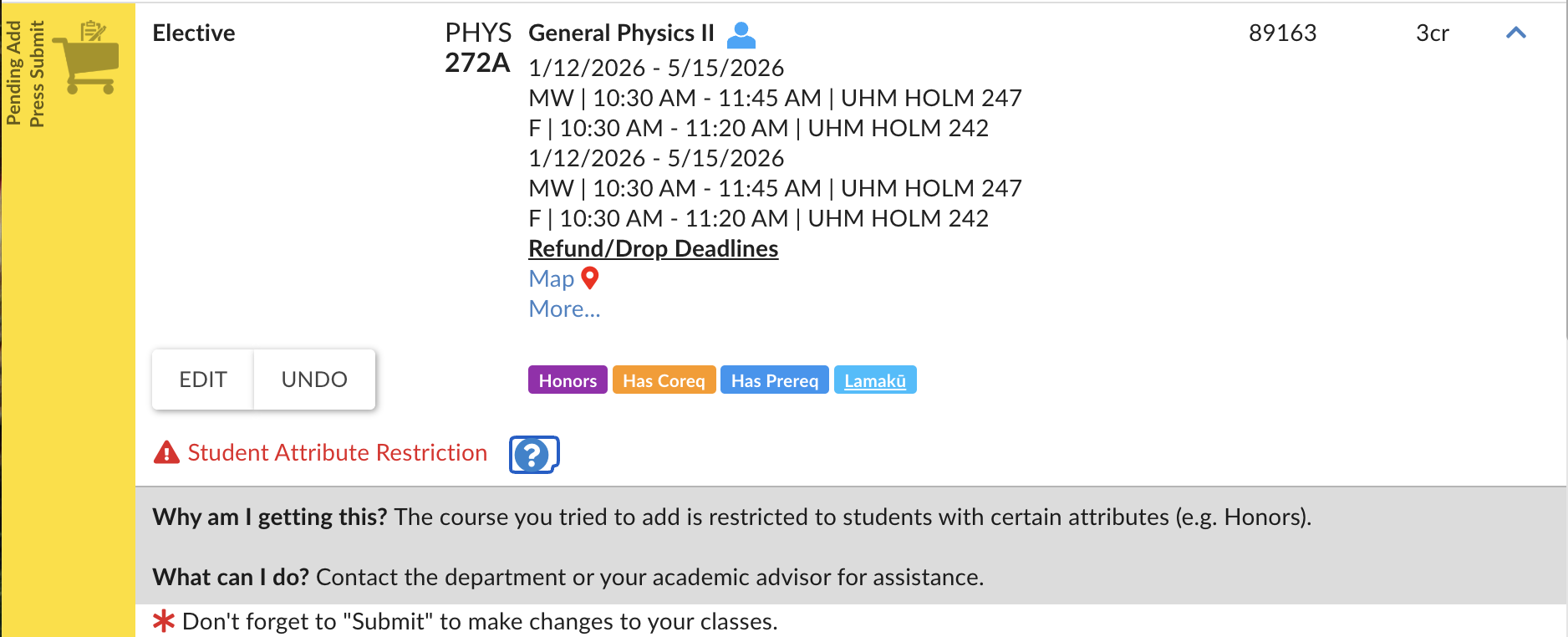 Because this course has prerequisites, I needed to ask the physics department office if I could waive it.
So I took my NTU transcript to ask if they could help me lift the restriction, and I successfully received a reply!
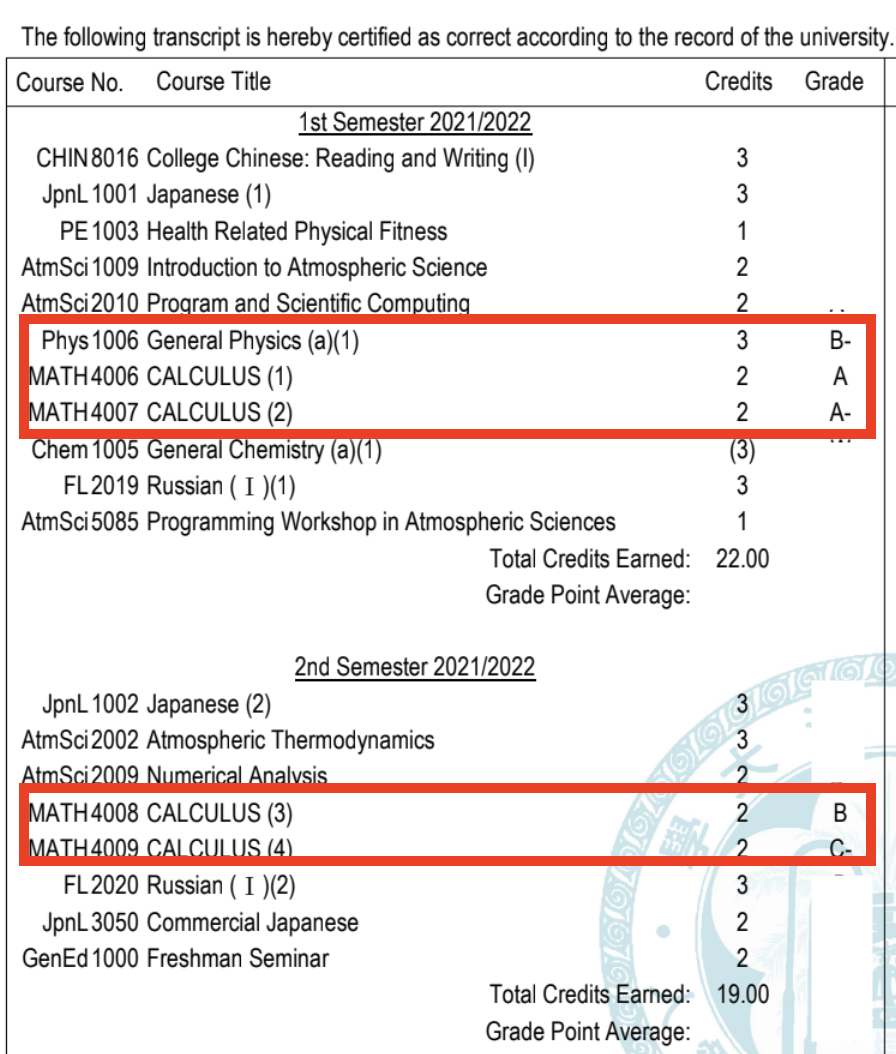 Although my grades aren’t great, thankfully the professor agreed
At the moment everything was finally confirmed, I truly breathed a sigh of relief.
This meant that as long as I successfully completed this course, I wouldn’t need to stretch for another semester or sacrifice my summer to make up credits after returning.
This process didn’t have any dramatic twists; it was just a matter of constant confirmation, waiting, and reconfirmation.
And the final result can only be summed up in one sentence — Heaven does not disappoint those who work hard; I succeeded.
Conclusion
After this weekend, I finally had a real sense that “school starts next week.”
Administrative processes, exams, moving into the dorm, social activities — each individual task doesn’t seem too difficult, but when they are all crammed together, it can indeed be a bit overwhelming.
However, at least so far, the tasks that needed to be completed have been gradually finished.
The rest will be left for after the semester starts, to walk and adapt along the way.